Stacking bed for guests

There are two popular stacking beds made in Germany. The first and original one is the modular stacking bed (Stapelliege) designed by Rolf Heide in 1966, produced by Müller Möbelswerkstätten.
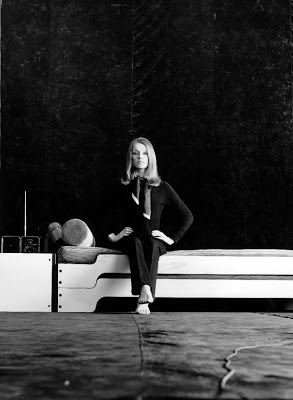

It is not only practical in a guestroom, but also for a kids room. We decided to take the short version of 1.90 m length for our son's room (because the room is so small). For future sleep overs he can accommodate his friends. Or when we have guests over night his room will transform into a guestroom.

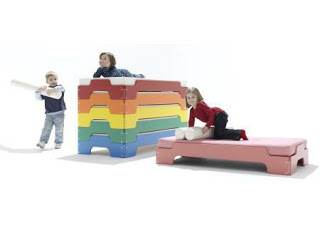
As the stacking bed became so popular for kids the manufacturer now also provides it in colourful and real small sizes:


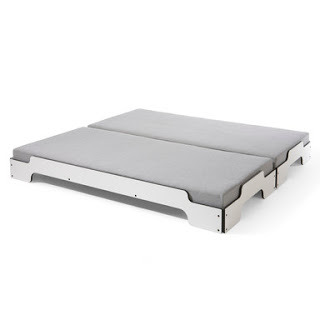
The alternative to Rolf Heide's 'Stapelliege' is the 'Lönneberga' bed designed by Alexander Seifried in 2007 for Richard Lampert.
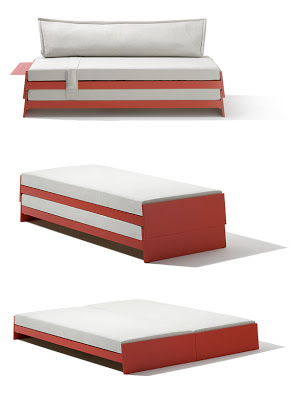


At the furniture Messe in Cologne in January 2009 a low budget version in white was presented. It will be available soon:
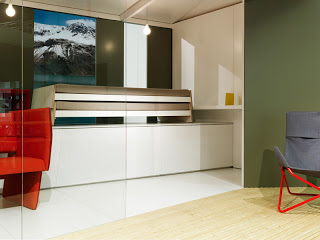


The overall size of this bed is 2.10 m x 0.95. No shorter version is available.

BTW, the name of this young stacking bed comes from the famous Swedish character 'Emil of Lönneberga', a tale by famous kid book author Astrid Lindgren. All accessories have names from the tale like 'Alfred' the cushion that stores bedding and serves as backrest for a fine daybed.

**********
This stacking bed is for our home in Germany. I am still busy with the fine tuning of its renovation. But hope to be back to the blog more often now. However I have no news on our 'Palazzo Project' for now. The outside is done. The inside to come.
What you need to know when buying property in Italy

"Missing building licenses and faulty cadastral registers („registro immobiliare”) can change the dream of a holiday residence into a nightmare. German home loan banks (Bausparkassen) are warning of pitfalls especially in Southern Italy."

In this post I partly translated an article that I found online via Financial Time Deutschland, 2004. I deem it necessary for interested property buyers to know some Italian specialties:

"Real estate in the Southern Italian provinces of Apulia, Campania and Calabria is still offered at good prices. The problem in these provinces is that often houses have been built without building license.

Nowadays, the authorities are controlling more strictly the building licences. Is a license missing or falsified, the owner needs to pay penalty or - worst case - demolition is requested. In consequence some owners try to sell quick and at attractive prices.
Therefore German home loan banks are warning of buying Italian property that is located South of Rome, and they do not accept these properties as security for a loan.

Deficient Cadastral registers in South Italy

Even if a house was legally built, there could be problems for the buyer, because the cadastral registers in many South Italian communities are insufficiently managed. Often encumbrances or partition of a property are not recorded. A perfect flawless cadastral register is no guarantee, that the buyer is buying the whole property or that it is encumbrance free.

Licensing Requirements prohibit modification or extension

Other problems might occur when buying a rustico in Italy. In some communities exists licensing requirements that prohibit that old farm houses can be modified or extended. It is recommended to get a lawyer or architect who should check before acquiring a property, if a) the building is in line with any building license and b) if the planned modifications or extensions are allowed. The German consumer protection recommends: You should not alone rely on the statements made by the owner who wants to sell or the real estate agent."

Details about Italian land register systems

In Italy are existing two different systems of land registration or cadastral registration. This has an historical background. While in some Northern provinces the principle of the 'constituent publicity' is in place, in all other Italian provinces the French tradition of land registration is in place.

1. The first system, the principle of 'constituent publicity' from 1929 means that the registration of a property at the land registry is legally binding. If you are registered as owner you are the owner by law. This is comparable with the principles of land registration in Austria and Germany.

2. However in the rest of Italy the actual system is based on the duty of cadastral registration without 'constituent publicity'. The registration has no healing effect when the transfer of property has deficiencies. Only by 'adverse possession' the deficiency can be cured. The period for adverse possession is 20 years (Art. 1158 Codice Civile), in case of good faith 10 years (Art. 1159 Codice Civile).

Therefore the buyer's notary and lawyer should do an intensive research about ownership and possible encumbrances or partition of the property by going back 20 years !

sources:
Financial Time Deutschland, 2004
and

  1. Italian land register law by Maître Giampettro Danieli & Rechtsanwalt Dr. Götz-Sebastian Hök

Tea in my Toilet and other bathroom deco


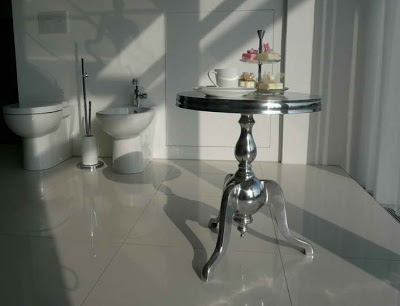
Today I went to another bathroom showroom to get ideas for a mirror solution (for our German bathroom) and to find accessories as towel hooks, toilet brush and toilet paper holders. Something you do not easily find in design blogs or magazines!

I like the window decoration (above) that I call 'tea in my toilet' (seen at Ottenbruch, Stuttgart-Filderstadt Germany). And I like the toilet brush set by Decor Walther. Although the brand name does not sound very sexy, they have some cool bathroom accessories.

Decor Walther brush set chrome / white porcelain (DW 6700), height 74 cm, foot Ø 17 cm, about 288 Euro - sigh!

More at their website:
Decor Walther
--- ---
See also my blogroll for more links under 'Bath Equipment'
--- ---

zoccolatura - or the wrong skirt


In Italy, a zoccolatura, a baseboard or SKIRTing board (I like the 'skirt' in the word) is often used at the base of facades. Some baseboards are simply made of grey plaster, some are made of stones of other shape or tonality than the rest of the facade.

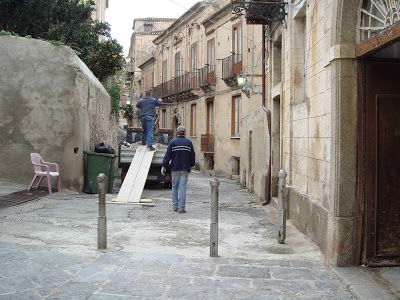
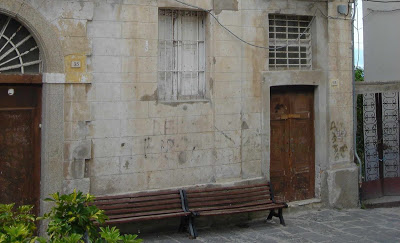
Below you see an older picture of our street. In front (right) is part of our palazzo, with the former zoccolatura of grey plaster. The neighbouring palazzo even has no zoccolatura.


The church, next by, Chiesa Carmine, has simply used brown paint to indicate a high baseboard (here behind the statue of Padre Pio, I need to find a better picture):


Another example of a beautiful zoccolatura can be offered by the main church of Lipari of Isole Eolie (see above first picture).

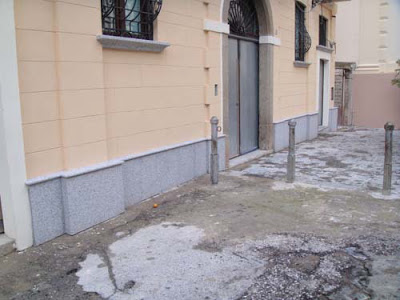
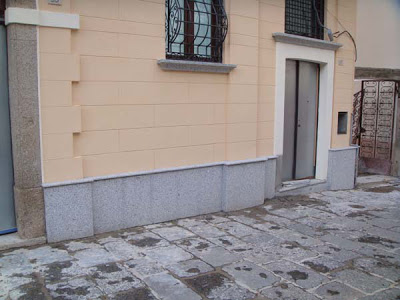
Well, well, and now we have our own new skirting board.
Made of my 'favorite' material, my grandfathers grave stone.
We inherited a few plates for the finishing of the balustrade from the previous owner. And it went on and on, for consistency, with window sills and door sills (remember my post about now I have to live with this) and now it is the zoccolatura:


These granite stones are not shiny. They have been treated with flames and the material on the top of the surface, due to thermal expansion, come out leaving an uneven surface. This is how the windows sills should have been treated.

I have to see it on site.
And if I still don't like it, my solution for the 'wrong skirt':


Put back the church's benches in place and the stones become invisible.

Again: A house that is older than 200 years should be restored in a way that preserves the old charm, the patina, the age ! - Sometimes less is more ! - Otherwise I can go on a green grassland and build a new house that suits my needs. - Of course it is also the dilemma of being not on the construction site myself.
---
Some more zoccolatura can be found around in my flickr set Italian doors.